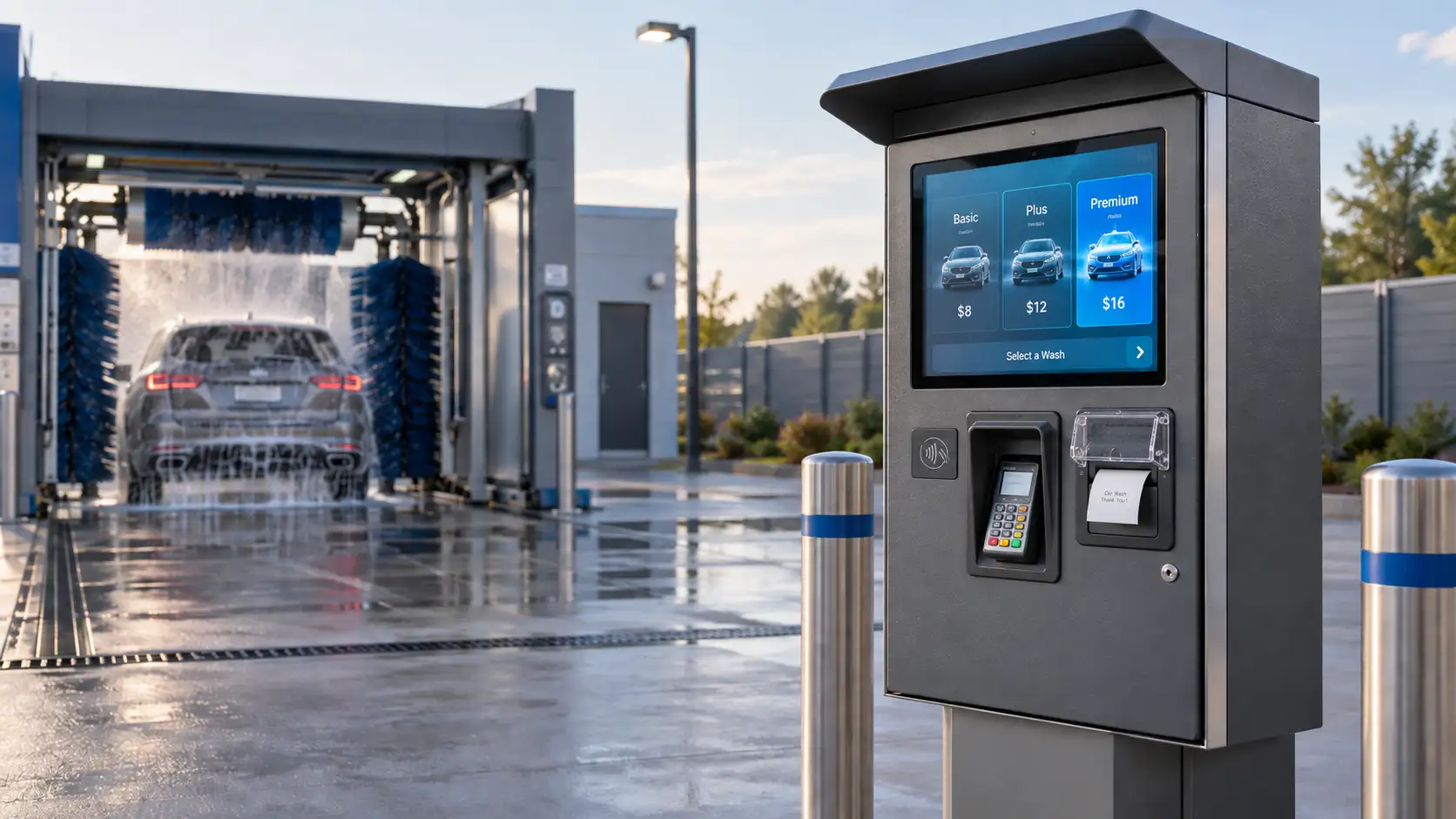
Choosing an outdoor payment kiosk for a car wash involves much more than comparing screen size, cabinet appearance or purchase price.
The kiosk sits between the customer, payment processing, the car wash controller and the wash equipment. If any link in that chain is unstable, operators can face payment completed but wash not started, reconciliation problems, machine downtime, unnecessary site visits and customer complaints.
Before purchasing, car wash operators should evaluate at least wash-machine compatibility, outdoor durability, payment software, cash handling, supplier support and long-term operating cost — not only whether a cabinet looks outdoor-ready.
1. Check Compatibility With Your Car Wash Equipment First
Before discussing screens, appearance or payment modules, confirm that the payment terminal can communicate with the existing wash machine.
Common connection methods include RS485, dry contact / relay, API or communication protocol, and gateway-based communication where required. CRTLY car wash kiosk projects currently support integration through RS485 and dry-contact interfaces for payment confirmation and wash activation. The final method depends on the wash controller, available documentation and the project configuration.
Operators should ask the wash-machine supplier for the car wash machine brand, controller model, communication interface, protocol documentation if available, number of wash programs, start / stop logic, and whether machine status can be returned — including busy, available or fault status when supported.
A good supplier should first ask: “How does your wash machine communicate, and what should happen after payment is completed?” That question is more useful than starting with “What payment methods do you need?”
Information to collect before configuration
- Car wash machine brand and controller model
- Communication interface (RS485, dry contact, API or gateway)
- Protocol documentation, if available
- Wash-program count and start / stop logic
- Whether busy / available / fault status can be returned
2. Evaluate the Supplier, Not Only the Kiosk
The cabinet is only one part of the purchase. Buyers should also investigate how long the supplier has worked with self-service kiosks, whether they have real car wash integration experience, whether hardware and software are developed or integrated by the same team, whether engineers can participate in integration, whether replacement parts are available, and whether long-term support is available.
CRTLY has more than 12 years of self-service kiosk experience and 5,000+ deployments across hotel, restaurant, parking, car wash, retail, hospital, currency exchange and other self-service industries. The practical value of that experience is not the headline number itself. Cross-industry projects repeatedly expose teams to payment devices, peripherals, industrial PCs, communications, cash handling, workflow exceptions and remote maintenance — problems that often appear only after equipment is in daily operation.
3. Understand the Support Channels Before You Buy
A car wash payment kiosk can include an industrial PC, touchscreen, bill acceptor, coin acceptor, coin dispenser, POS terminal, printer, network equipment and controller communication. The useful question is not only whether the machine can fail. It is: when something goes wrong, who can identify which part of the system caused the problem?
CRTLY sales staff complete approximately 90 days of product and project training before independently handling projects. Online technical support is available, and urgent technical issues can be escalated to CRTLY engineers for remote assistance. The standard warranty is one year; covered replacement parts are provided during the warranty period, and spare-parts support remains available after the warranty period.
4. Outdoor Durability Matters More Than Appearance
Typical car wash sites expose payment terminals to rain, splash water, humidity, direct sunlight, UV, summer heat, low winter temperatures, dust and corrosion. Instead of asking only “Is the kiosk waterproof?”, buyers should ask how the kiosk has been engineered to remain stable outdoors for several years.
Cabinet Material and Corrosion Protection
CRTLY can provide 304 stainless steel or properly treated galvanized steel according to the project budget and installation environment. Outdoor-grade coating systems can be applied to improve UV and corrosion resistance. Material, surface treatment and enclosure construction should be selected according to climate, corrosion exposure and project budget.
For enclosure materials, airflow, drainage and display engineering detail, see the Outdoor Payment Kiosk Weatherproof Design Guide.
5. Ask What Happens in Hot, Cold and Rainy Weather
Weather questions should be treated as a purchasing checklist, not as a full engineering lecture.
Hot weather
- Confirm kiosk operating temperature, screen temperature range and industrial PC operating temperature.
- Ask about cooling method, internal airflow and whether air conditioning is required in extreme climates.
- Remember that high-brightness displays, industrial PCs, POS terminals and payment modules all generate heat, while direct sunlight increases enclosure thermal load.
Cold weather
- Confirm low-temperature startup and LCD temperature range.
- Confirm bill / coin mechanism temperature range.
- Ask about optional heating and condensation control.
Rain and splash water
- Ask how ventilation openings, payment-module openings and receipt outlets are protected.
- Confirm protected airflow paths and internal drainage where applicable.
Read our Outdoor Payment Kiosk Weatherproof Design Guide for the detailed engineering discussion.
6. Evaluate the Software as Carefully as the Hardware
Many buyers ask mainly about screen size, bill acceptor, POS terminal or IP rating. After go-live, software reliability is equally important.
Operators should confirm whether wash-package names, wash prices and other routine operating parameters can be changed directly from the management system without recompiling the kiosk application.
A practical question is: “Can I change normal operating parameters myself, or does every price change require software redevelopment?”
When the CRTLY car wash management back office is included, operators can manage wash-package names and pricing from the management system. Exact editable parameters depend on the project configuration and should be confirmed before purchase.
7. What Happens if the Car Wash Machine Has a Fault?
In CRTLY car wash projects, the kiosk application can monitor the operating status returned by the connected wash equipment.
When the wash system reports that it is unavailable or in a fault state, the application can restrict the wash-program and payment flow so that customers are not guided into paying for a service that cannot currently be delivered.
In practical terms: wash equipment unavailable → status identified → wash-program / payment flow restricted → payment for the unavailable wash service is avoided. This logic helps reduce cases where a customer pays successfully but the wash machine cannot provide the purchased service.
This logic depends on the connected wash controller providing the required status information.
8. Payment and Change Errors Need a Reconciliation Mechanism
Cash and mixed-payment sites can encounter insufficient change inventory, coin dispenser jams, payment-device errors, communication interruption, software believing payout completed while physical payout was incomplete, or mismatched payment and device states.
The important question is not whether exceptions can happen. It is: what records are available after an exception happens?
In CRTLY car wash payment projects, every transaction has a unique order number. For applicable payment or change exceptions, the system can create a PendingSettlement record linked to that transaction.
The record can preserve information such as actual amount received, amount already returned or dispensed, remaining settlement information and the related order number.
These records help operators investigate, reconcile, trace and verify what happened during an abnormal payment or change transaction.
9. Cash Replenishment Should Not Be Counted as Sales Revenue
Cash-enabled kiosks need regular replenishment of coins or notes used for change. That replenishment cash should not be treated as the same day’s customer sales revenue.
CRTLY provides a dedicated replenishment function in the back-office system so that money inserted for change inventory is separated from normal customer sales transactions. The result is cleaner reconciliation, more accurate daily revenue reporting and easier cash management for unattended car wash sites.
10. Remote Management Matters for Unattended Car Wash Sites
Unattended sites make remote visibility part of normal operations. Buyers should check whether they can review transaction history, payment status, PendingSettlement and other supported exception records, wash-equipment status and revenue data without sending staff to the site for every issue.
CRTLY car wash projects can include cloud monitoring of revenue, transaction records and operating data so operators can confirm results and investigate issues remotely. For the broader system view, see the car wash payment solution. Exact remote-management scope should be confirmed against the project configuration.
11. Check Manufacturing Quality and Product Compliance
Buyers should ask about the quality-management system, applicable certifications, production procedures, electrical testing, final inspection and outdoor testing where applicable.
CRTLY operates under an ISO 9001:2015 quality management system. CE, CB, FCC and RoHS compliance or certification documentation is available for applicable products and configurations. Buyers should confirm the documentation required for the specific kiosk configuration and destination market.
12. Compare Total Cost of Ownership, Not Only Purchase Price
A lower purchase price does not necessarily mean a lower operating cost. For unattended equipment, buyers should compare kiosk purchase price together with payment modules, software, integration, shipping, installation, cash handling, maintenance, replacement parts, downtime, site visits, technical support and expected service life.
For car wash operators, downtime and unnecessary on-site service visits can outweigh a small difference in initial hardware price. Total cost of ownership is therefore a more useful decision frame than cabinet cost alone.
When you are ready to map these buying criteria to a deployment scenario, review the car wash payment kiosk application page for the outdoor application context.
Outdoor Car Wash Payment Kiosk Buying Checklist
Use the checklist below before requesting quotations. Each item is written as a question an operator can ask a supplier directly.
Integration
Can the kiosk communicate with my existing wash controller? Confirm whether the interface is RS485, dry contact, API or gateway. CRTLY car wash projects currently support RS485 and dry-contact integration; other interfaces require project-specific evaluation.
Equipment status
Can the kiosk identify when the wash machine is unavailable or in a fault state? This depends on whether the wash controller can return the required status information to the kiosk application.
Payment and change
What happens if payment or cash change cannot be completed normally? Can the transaction be traced by a unique order number, and is a PendingSettlement record available for reconciliation?
Software and cash operation
Can wash-package names and prices be changed from the back office without recompiling the kiosk application? Is replenishment cash separated from normal sales revenue?
Outdoor protection and cabinet
How are rain, heat, cold, UV and corrosion handled for this site? Will the cabinet use 304 stainless steel or properly treated galvanized steel with outdoor-grade coating?
Remote management, support and cost
Can transactions and exceptions be reviewed remotely? What support channels and engineer escalation are available? Confirm one-year warranty, spare-parts support after warranty and total cost of ownership beyond the purchase price.