Intro
A Malaysian bus terminal deployed CRTLY B Series desktop kiosks for self-service bus ticket purchasing.
The customer runs its own ticketing software, while the CRTLY kiosks provide the hardware platform required for passenger interaction, POS payment and ticket printing.
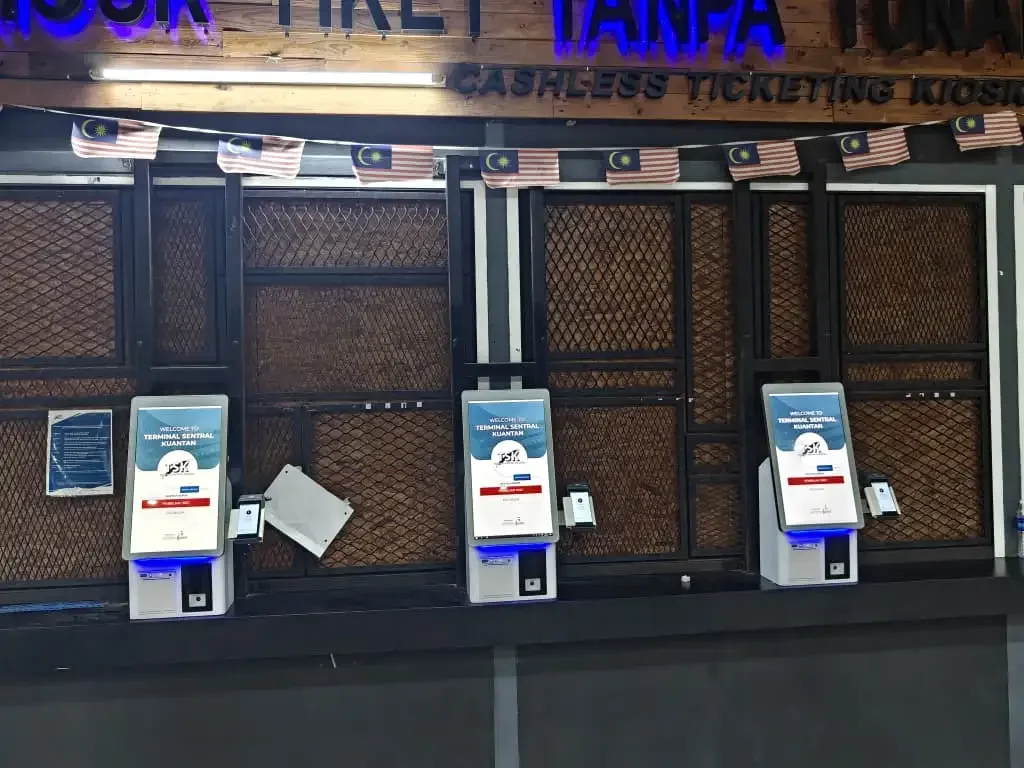
The kiosks were placed on the existing ticket-counter surface, allowing the operator to add self-service ticket purchasing without introducing additional freestanding floor units into the passenger area.
Project Overview: Bus Ticket Kiosks in Malaysia
This project uses the CRTLY B Series as a compact wall-mounted ticketing terminal inside a Malaysian bus station.
Multiple kiosks were installed side by side along the existing ticket-counter structure. Each unit runs the customer's own ticketing application and connects to the payment and printing hardware required for the passenger transaction.
Project Snapshot
| Column A | Column B |
|---|---|
| Field | Project Configuration |
| Location | Malaysia |
| Application | Self-service bus ticket sales |
| Kiosk | CRTLY B Series |
| Installation | Desktop / countertop |
| Software | Customer-provided ticketing software |
| Payment | POS terminal |
| Output | Printed ticket / receipt |
| Deployment | Multiple kiosks |
How the Passenger Ticket Purchase Flow Works
The passenger purchase process is controlled by the customer's ticketing software.
The CRTLY kiosk provides the touchscreen, hardware platform and peripheral integration required to run this process.
Actual Ticket Purchase Workflow
The customer also shared a video of the deployed kiosk in operation, showing the actual passenger flow from ticket selection and fare calculation to POS payment and ticket printing.
How the Customer's Ticketing Software Runs on CRTLY Hardware
This project uses the customer's existing ticketing software rather than a CRTLY-developed ticketing platform.
The customer controls the ticketing application, route information, fare calculation and booking logic.
CRTLY supplies the kiosk hardware platform around that software environment.
Depending on the project, the hardware configuration can include:
- touchscreen display
- industrial PC
- printer
- POS mounting position
- cable routing
- network connectivity
- required hardware communication interfaces
- wall-mounted cabinet configuration
This allows transport operators and software companies to keep their existing ticketing system while using a dedicated self-service kiosk for passenger transactions.
Heading
For this deployment, the B Series kiosks were placed on the existing ticket-counter surface rather than installed as freestanding floor units.
This allowed the operator to add self-service ticketing terminals within the existing counter area while keeping the passenger circulation space largely unchanged.
The B Series can also support wall-mounted installation for other projects, but this Malaysia deployment used a desktop / countertop configuration.
POS Payment and Ticket Printing
Payment is completed through a POS terminal installed alongside the kiosk.
The exact POS model and payment service depend on the customer's local payment environment.
When a customer supplies its own POS terminal, CRTLY can reserve the installation position, adapt the kiosk structure around the confirmed terminal size and provide the required hardware interface.
After payment is completed, the ticketing software triggers the printer to produce the ticket or receipt required by the passenger workflow.
CRTLY does not act as the payment processor or acquirer in this type of project.
What CRTLY Supplied for This Project
For this Malaysia deployment, CRTLY's role was focused on the kiosk hardware platform rather than the ticketing business software.
The project configuration included the B Series kiosk hardware, wall-mounted cabinet design, touchscreen, computer platform, printer integration, POS installation arrangement and the required hardware interfaces.
The customer remained responsible for the ticketing software, route data, fare logic and booking workflow.
This separation allows the kiosk hardware to be adapted around an existing ticketing platform without requiring the customer to replace its software system.
What This Deployment Shows for Other Ticketing Projects
The important part of this project is not simply that several kiosks were installed at a bus terminal.
It shows how an existing ticketing software platform can be deployed on dedicated self-service kiosk hardware while keeping the software and business logic under the customer's control.
For transport operators, ticketing software companies and system integrators, this type of architecture can be useful when the software platform already exists but a dedicated passenger-facing kiosk is needed for ticket selection, payment and printing.
CRTLY can configure the kiosk hardware around the required software environment, installation method and peripheral combination for the project.
9. FAQ
Can CRTLY kiosks run a customer's existing ticketing software?
Yes. In this Malaysia project, the customer installed and operated its own ticketing software on the CRTLY B Series kiosk. The kiosk hardware can be configured around the software and peripheral requirements of the project.
Can a bus ticket kiosk integrate a POS terminal?
Yes. A POS terminal can be incorporated into the kiosk configuration. If the POS is supplied by the customer, CRTLY can reserve the mounting position and required hardware interface based on the confirmed terminal model.
Can the kiosk print a ticket after payment?
Yes. A printer can be integrated into the kiosk so the ticketing application can produce a printed ticket or receipt after the transaction is completed.
Can the B Series kiosk be wall-mounted?
Yes. The B Series can support wall-mounted installation depending on project requirements. However, the kiosks used in this Malaysia bus ticket project were deployed as desktop / countertop units on the existing ticket-counter surface.
What does CRTLY supply for a customer-developed ticketing system?
CRTLY can supply the kiosk hardware platform, touchscreen, industrial PC, printer integration, POS mounting arrangement, cabinet structure and required hardware interfaces. The customer can continue using its own ticketing software and business logic.